




Can’t squat or lunge? This suspension trainer-assisted workout helps target the same muscles while sparing your joints
If squats and lunges are too hard on your joints, use this four-move sesion workout to build strength and master the form


Squats and lunges are not easy.
They require ample ankle and hip mobility, a stable core to brace the spine and hold your posture in an upright position, not to mention strong thighs and glutes.
Most beginners I’ve encountered as a personal trainer have struggled with this move—and plenty of vastly experienced exercisers too.
But these exercises are worth persevering with because of the life-improving effect on your overall strength, mobility and confidence when undertaking everyday activities, like climbing a flight of stairs or getting in and out of a chair.
Over the years, I’ve found that using a suspension trainer, like a TRX system, can help complete beginners learn the basics of these invaluable exercises.
How suspension trainers help with squats and lunges
Suspension trainers, which can be anchored over a closed door if exercising from home, let you take the strain with your hands to lighten the load on creaking joints.
This allows you to better control the lowering phase of moves like squats and lunges so you can work around any range of motion limitations and build strength safely.
To show you what I mean, I’ve programmed the workout below using a suspension trainer. The four lower-body exercises will help you learn and then master the movement patterns involved in a bodyweight squat, reverse lunge and Cossack squat (akin to a side lunge).
The workout will strengthen your glutes, quadriceps and hamstrings, while improving the range of motion and mobility around your ankles, knees and hips in a safe, controlled fashion.
How to do the 15-minute suspension trainer workout
To perform this workout, attach a suspension trainer to a high anchor point. If at home, most systems come with a door anchor so you can secure at the top of a closed door. Just make sure you close the door towards you.
Before you start, spend a few minutes marching on the spot, gradually increasing how high you lift your knees, to slowly raise your heart rate and warm up your lower body.
When ready, perform exercise 1A, then move straight onto exercise 1B. Rest for 30 seconds, then go back to exercise 1A and repeat the sequence. Continue until you’ve completed the sequence thee times in total.
Then apply the same routine to exercises 2A and 2B, again completing the sequence three times in total.
Repeat this routine once or twice a week to gradually build up your strength and mobility until you can perform these exercises with minimal assistance from the suspension trainer or completely unsupported.
1A. Suspension trainer squat
Sets: 3 Reps: 10-12
How to do it:
- Stand with your feet hip-width apart and grasp the suspension trainer handles.
- Lean back slightly so your weight is over your heels, with your arms supporting your weight.
- Bend your knees and sit your hips back to slowly lower, keeping your gaze forward.
- Pause for a moment when your knees are bent to 90˚.
- Drive your hips forward to stand upright.
- Don’t let your knees cave in during any part of the movement.
1B. Suspension trainer squat hold
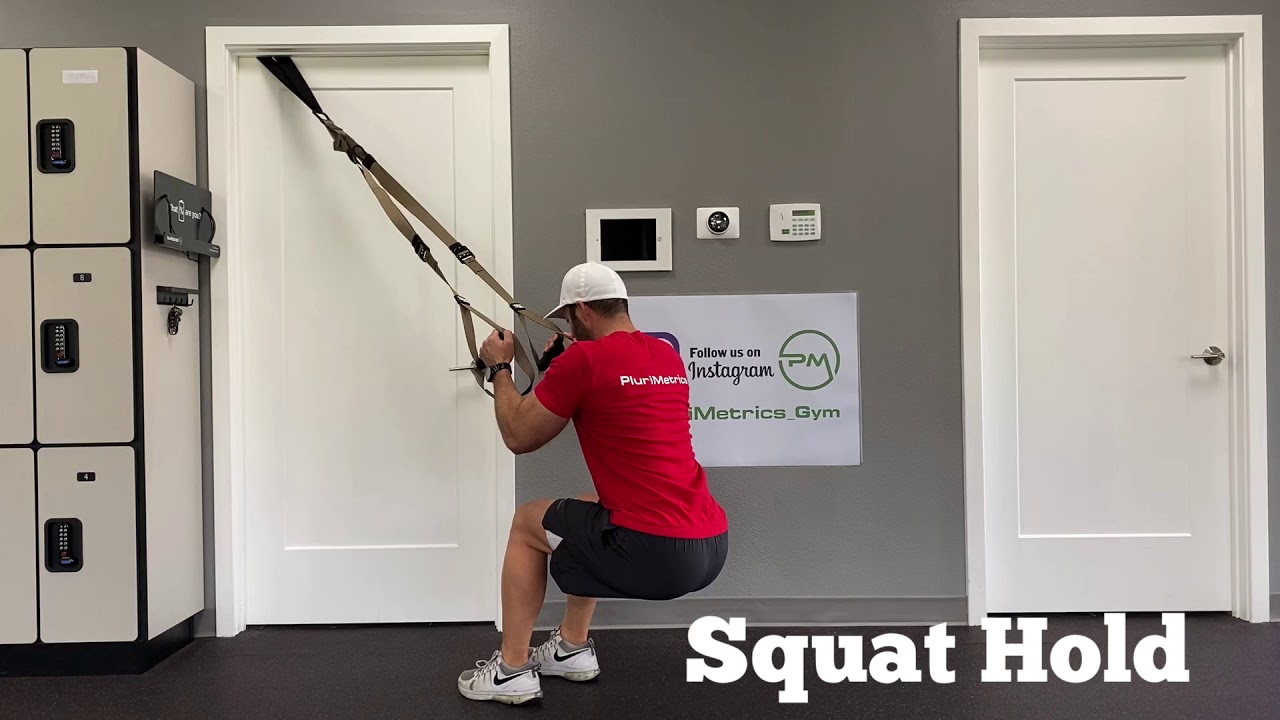
Sets: 3 Time: 20-30sec
This isometric hold will build strength while helping to preserve your joints.
How to do it:
- Stand with your feet hip-width apart and grasp the suspension trainer handles.
- Lean back slightly so your weight is over your heels, with your arms supporting your weight.
- Bend your knees and sit your hips back to slowly lower, keeping your gaze forward.
- Stop when your knees are bent to 90˚ and hold this position for 20-30sec.
- Keep your weight in your heels and knees directly over your knees, breathing steadily during the hold.
- Breathe normally, in through your nose and out through your nose.
- Drive your hips forward to stand upright.
2A. Suspension trainer reverse lunge

Sets: 3 Reps: 8-10 each side
How to do it:
- Stand with your feet hip-width apart, holding the suspension trainer handles.
- Step back until the straps are taut, so you can use your arms to support your bodyweight as you perform the exercise.
- Take a big step back with your right foot, placing the ball of your right foot on the floor behind you.
- Bend your knees to lower, keeping your left foot flat on the floor.
- Allow your right knee to very gently tap the floor, then push through your left foot to return to standing.
- Repeat on the other side.
- Continue, alternating sides with each rep.
2B. Suspension trainer Cossack squat
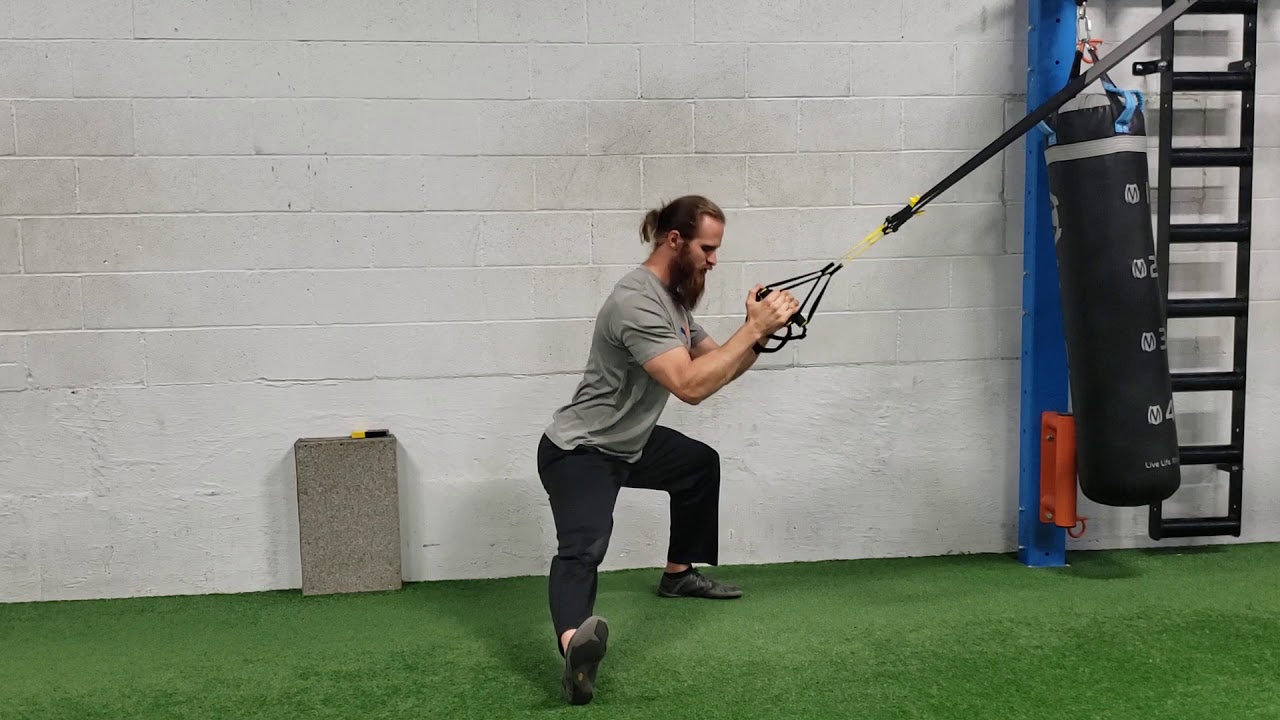
Sets: 3 Reps: 8-10 each side
This exercise will especially challenge your lateral range of motion, which is often overlooked so don't worry if your range is limited at first. There’s every chance you’ll also rely heavily on your arms to take most of your weight at first.
How to do it:
- Stand with your feet wider than shoulder-width apart, toes slightly pointing out, holding the suspension trainer handles.
- Shift your hips to the left, bending your left knee and keeping your weight over your left heel.
- Keep your right leg straight, pivoting on your heel and allowing your toes to lift and point straight up if this feels comfortable.
- Lower your hips as far as you can manage, then push through your left heel to return to the start.
- Repeat on the other side.
- Continue, alternating sides with each rep.
- As you shift from side to side, lubricating your joints, you should notice your range of motion slightly improve.
Shop suspension trainers


