An osteopath urges everyone to do this one daily stretch to undo the damage caused by prolonged sitting—it only takes three minutes
Use it to prevent the common hunchback posture that afflicts desk workers


There is no single remedy that will reverse the damage done by prolonged sitting, says associate osteopath Andy McIntyre BOst MSc from The Livewell Clinic in London.
“But there are two areas that, for me, take the biggest brunt from sedentary postures,” he tells Fit&Well.
The first one is the hips, which he says can be addressed by practicing gentle hinging movements like good mornings and deadlifts.
The other pain point tends to be the "mid thoracic" area. This refers to the middle section of the spine, around the T1 to T12 of the vertebrae between the neck (cervical spine) and lower back (lumbar spine).
“We all hunch forward when sat at a desk,” McIntyre explains. “We get kyphotic. Our shoulders drop forward. Our mid and upper back rounds.”
To compensate, these vertebrae can stiffen, which further restricts the range of motion for everyday tasks.
“Our bodies are very clever. To adapt to this [hunched position] joints stiffen up in our mid-back so we require less energy to hold ourselves there all the time,” he says.
“When we then come to use our shoulders, when we come to run, when we do anything else, that stiffness is still there.”
As a result, the shoulders and other parts of the spine, like the neck, have to compensate and work harder to do basic things, like look over our shoulders.
“Just like how we decondition our hips by being at a desk, we are deconditioning our thoracic spine all the time when sat forward in this hunched position.”
How to mobilize the thoracic spine
To arrest and reverse this deconditioning, McIntyre says we should all be working on thoracic extension and rotation in order to “undo the damage from being chained to a desk all the time”.
“One of the best ways of unlocking extension is through thoracic rotation,” he says. “If our spine can rotate, then it will be able to do all the other planes of motion much more easily.”
For McIntyre, that means practicing an exercise called open the book first thing in the morning and last thing at night.
If extra time allows, he also performs the thread the needle exercise, which similarly targets the thoracic spine—though he favors the open the book exercise if he had to choose.
“The best moves for thoracics are anything that involves rotation either flat to a mat or flat to a wall,” says McIntyre, because it will “force us to bias our thoracic spine”.
“I do those [two exercises] pretty much every day and though I’m not at a desk as much as some people can be, even I notice the stiffness quite significantly.”
How to do the open the book stretch
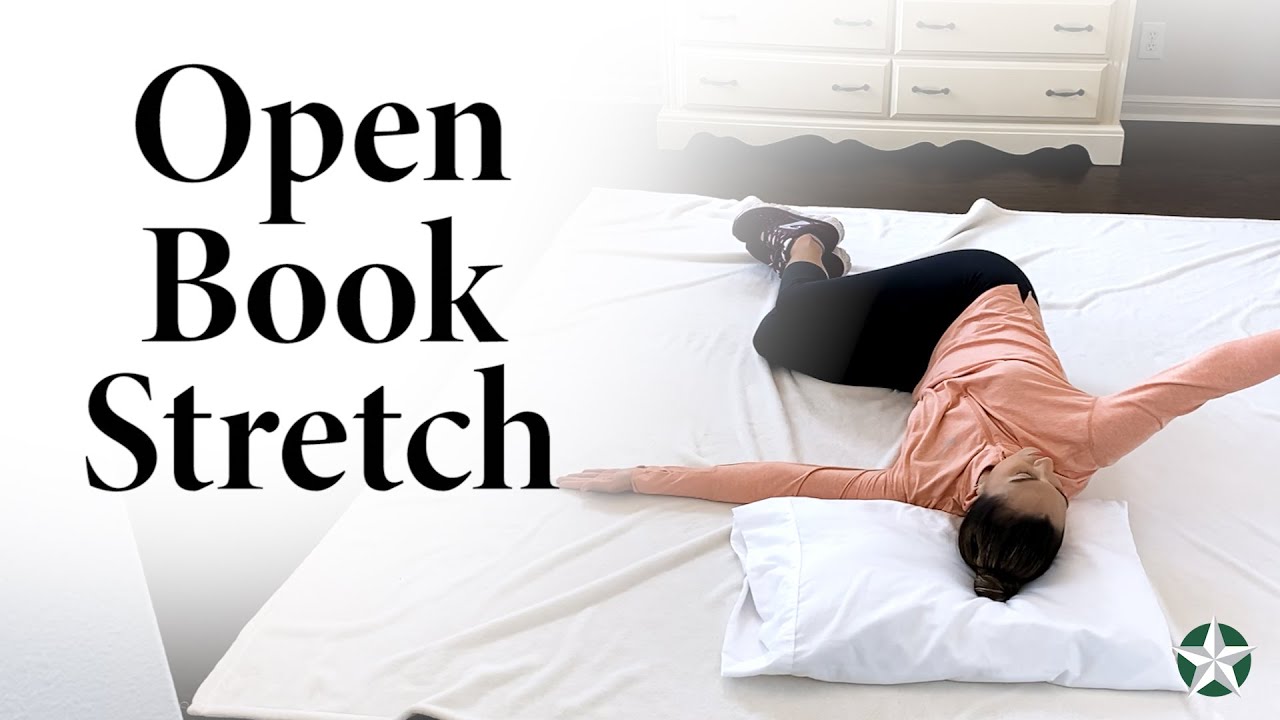
Sets: 3 Time: 30-60sec each side
- Lie on your side with your hands, feet and knees together, knees bent and arms extending in front of you.
- Keeping your feet and knees together and in contact with the floor, slowly raise your top hand and rotate your torso so your hand moves up and over your body toward the floor on the other side.
- Rotate as far as you can comfortably while keeping your knees and feet grounded—you might not be able to reach the floor on your other side at first.
- Slowly rotate your arm back to the start position.
- Breathe deeply, slow and steady throughout the stretch, allowing tension to release through your thoracic spine with each exhale.
Notes on form
The open the book stretch is fundamentally the reverse of the thread the needle exercise, says McIntyre.
“Instead of closing your chest underneath you, you're opening your chest and rolling over to the opposite side,“ he says.
“Your knees are bent at 90˚, but you want to keep them as fixed as possible. You want the pelvis and knees to be fixed to the floor, so all the movement comes from the thoracic spine."
McIntyre says it helps to follow your hands with your gaze. “Look over your shoulder to follow that arm. That helps encourage rotation through your entire thoracic spine.”
In the morning, McIntyre does three sets of one minute on each side, but if you’re just starting out you can begin with just 30 seconds each side, so three minutes in total.

Andy McIntyre B.Ost (Bachelors of Osteopathy) is an osteopath registered with the General Osteopathic Council, who works at The Livewell Clinic in Clapham Junction, London. Having originally worked as a software developer, he changed his career towards sports massage and osteopathy, training at the London School of Osteopathy, and has since explored further training in 3D movement analysis and postural assessment to better assist his clients. He works with the generally desk-bound public as well as more highly-trained athletes to help get them out of pain and into better movement patterns.
