Beginner runners are always told to run slower but it’s harder than it sounds—I’m a running coach and these five techniques actually work
Start to enjoy your runs with these simple tips


There’s one piece of advice that every new runner has probably heard: You need to slow down.
I’ve dished out this advice to nearly every new client I coach—not to mention friends and family members who tell me that they hate their runs.
While boring routes, darkness, or bad kit certainly play a role, more often than not, it’s because they’re out of breath.
Slowing down will relax your breathing and make the physical exertion feel more manageable.
It can also give you the time and mental capacity to think about—and improve—your running technique. These factors can all lead to a much more enjoyable run—and stop you from giving up on running altogether.
And for seasoned runners, incorporating some slower runs into your schedule can actually help improve your aerobic capacity and make you a faster runner.
But how do you slow down? It’s easier said than done. Running slowly doesn’t come naturally, and can feel weird when we live in a world that encourages us to get things done as quickly as possible.
I’ve got a number of techniques that I share with running clients to help them slow down, and I still use many of them myself. Give them a try and share which worked for you in the comments.
1. Pivot from distance to timed runs
I’ve had clients come to me because they are frustrated that, despite the fact they’ve been running for a few months and managed to increase the distance they’re running, the runs are not getting any easier, and still aren’t enjoyable.
My advice is always to stop worrying about distance and instead start concentrating on time.
A lot of runners become fixated on running further or faster. Instead, set yourself a time for how long your next run will be, this could be 15, 20 or 30 minutes—or longer depending on your current ability.
Run at a relaxed pace, slowing down or even walking if you get out of breath.
Remember that going faster isn’t going to make the run end any sooner—you still have to finish the allotted time.
Increase the time by five minutes every few weeks and you’ll find that you’re running further without hating your runs.
2. Find a running buddy

Running with a friend is a good way of slowing yourself down, especially if they happen to run at a slower pace than you.
If that’s the case, let your friend set the pace, keep at their side or a step behind so you don’t encourage them to run faster than they otherwise would. It’s a good idea to let your friend know what your aim is to discourage them from speeding up.
If you don’t have a friend who runs at a slower pace that’s still OK—any running buddy will do. Make a pact to run slow enough to keep a conversation going, and you will automatically run a bit slower than normal.
Another good tactic is to think of the run as a catch-up rather than exercise; this will help take the pressure off even more.
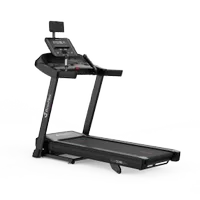
3. Use a treadmill
The best way to force yourself to run slower is to put someone or something else in charge. Take the responsibility away from yourself and jump on a treadmill.
Set a slower-than-usual pace on the machine and stick with it—the only way you’re allowed to change the setting is to make it slower.
If you have access to a treadmill with a TV screen, watching something you enjoy can make the time feel like it’s passing a little quicker.
4. Check your heart rate
One of the techniques I often use on my own slow runs is to monitor my heart rate. I do this by using my Apple Watch, but every smartwatch and fitness tracker nowadays will have a built-in heart rate monitor.
Personally, my strategy is to make sure my heart rate never goes above 145 beats per minute (BPM). If it looks like it’s getting close, I’ll slow down even more.
This number will be different for everyone and there are a few ways of establishing the best BPM target for you.
The simplest way is to check your average heart rate at the end of a run, then choose a number that’s lower than that.
If you want to be more accurate, you can use a slightly more complex measurement, which relies on heart rate zones to work out a BPM range to stay within.
There are five zones, if you can stay in zones 2 and 3, you’re likely to be running slow enough. If you know your maximum heart rate (if you don’t, you can estimate it), you can use this zone calculator to work out your zones 2 and 3 BPM.
5. Switch music to a podcast or audiobook
One of the techniques I use to run faster is to listen to music. I’ve made many dance music playlists for racing in marathons and ultramarathons, because I can normally synchronize my stride to the faster BPM, which makes me run faster.
So, when I want to run slower, I do the opposite. Fast beats are switched out for podcasts and audiobooks.
Not only does this slow your stride, but concentrating on stories and opinions gives you something else to think about during the run, which can also help you slow down.
