I’m a personal trainer who works with seniors—this is the one upper-body move everyone over 65 should be doing
Strengthen important muscles in your back and shoulders with banded rows


Strengthening your back is important at every age, but it’s especially vital for seniors.
Whenever I work with clients over 65, I make sure to include banded rows in their regimen. This movement strengthens important muscle groups in the upper body, improves posture and stability, and can make everyday tasks easier.
As you age, you’re more susceptible to bone and muscle loss. This can, in turn, negatively affect your posture, worsen your balance, and make tasks like lifting heavy items or reaching for things more difficult.
Banded rows work the latissimus dorsi, middle and lower trapezius and rhomboids—muscles that are responsible for supporting your back, chest, and shoulders, maintaining proper postural alignment, and moving your upper body.
It’s an exercise that’s easy on the joints, safe for most fitness levels, and helpful for maintaining independence. It can also combat bone loss by improving muscle tone and strength.
However, you don’t have to be a senior to benefit from banded rows. If you’ve got a band, you can start incorporating this move into your regular upper-body workout now.
How to do banded rows
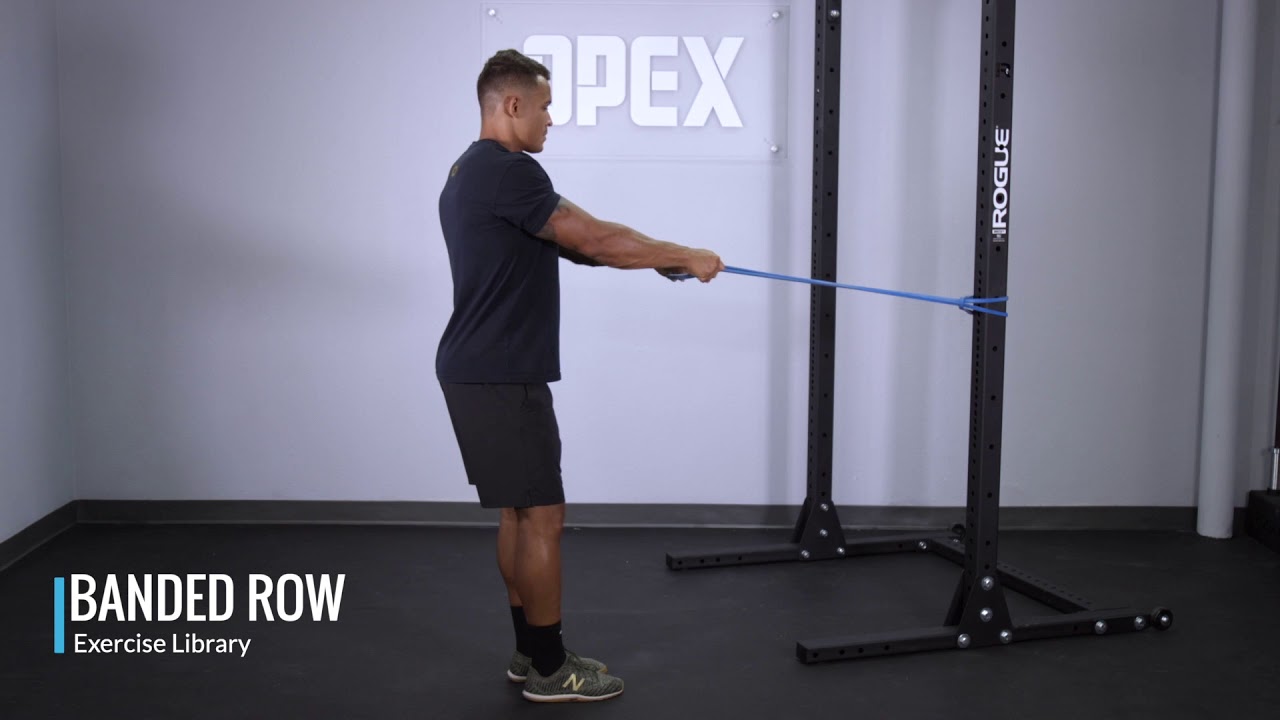
Check in with your doctor before beginning any new exercise or routine.
You’ll need a moderately-heavy resistance band and a strong anchor point for this exercise, such as a stair railing.
If you’re a beginner, start with one set of 10 reps. As you get stronger and more conditioned, increase your reps to 12. Keep gradually increasing your reps and sets until you can do 3 sets of 15 reps comfortably.
Sets: 1-3 Reps: 10-15
- Loop a resistance band around a secure anchor point.
- Grab the opposite end of the band with both hands and step back.
- Engage your core muscles.
- Squeeze your shoulder blades together and pull the band towards you.
- Hold for a few seconds.
- Slowly extend your arms with control to return to the starting position.
Trainer tips: Maintain a tall, neutral spine and avoid slouching forward. Keep your elbows close to the torso as you pull the band toward you. Relax your shoulders, aiming them down and away from your ears. Avoid any excessive arching in the lower back.
Shop Theraband resistance bands
