A strength specialist’s simple techniques to get stronger glutes at home without equipment
All you need is an elevated surface and these three exercises to keep challenging your glutes


If you want to build strength, then you need to follow the principle of progressive overload, gradually increasing the challenge to your muscles over time. The most obvious way to do this is by using heavier and heavier weights—but it’s not the only way.
Certified strength and conditioning specialist Alexander Erickson, who works at Just Train by Joel Thomas, explained to me that there are multiple ways to increase the difficulty of your workouts that don’t involve different weights, so you can follow progressive overload without a gym membership or a set of home dumbbells.
Five ways to progressively overload without equipment
- Add more reps or sets: The easiest way to progress, although this becomes too time consuming to be practical after a while.
- Increase time under tension: Slow down the movement (on the way down especially), and/or hold the position at the bottom of the movement for a few seconds, to make it more challenging.
- Add instability: Adding some form of instability with a soft surface like a sofa cushion, can increase the difficulty of the exercise, because your body has to work harder to stay balanced. Another idea is to go from a bilateral to a unilateral exercise, where possible.
- Increase the intensity: Work against a timer, with as many rounds as possible (AMRAP) workouts, or Tabata high-intensity interval training protocols.
- Increase the frequency of workouts: Just add an extra session to your week.
“Ultimately, it’s about being creative, finding new ways to challenge yourself and making the necessary adjustments,” Erickson says.
How to build stronger glutes without weights
To put these techniques into practice, Erickson recommends the following three equipment-free glute exercises, which only require an elevated surface to perform.
Here’s how to do them, and the techniques you can employ to make each more challenging as you get stronger.
1. Bulgarian split squat
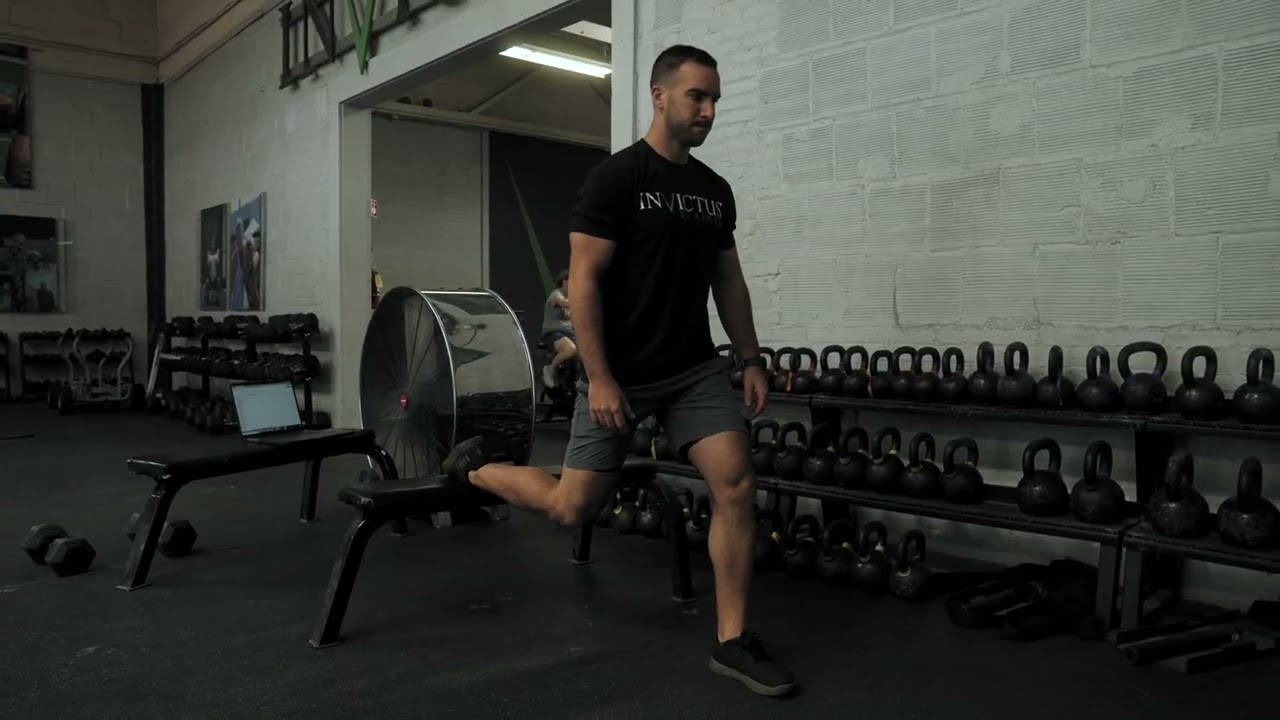
Sets: 3 Reps: 6-10 each side
How to do it:
- Stand facing away from an elevated platform—a bench, step, box or chair—and take a step away from it.
- Place the top of your left foot on the platform.
- Bend your right knee to lower, stopping just before your left knee touches the floor, or as low as feels comfortable.
- Push through your right foot to extend your right leg and return to the starting position
- Do all your reps on one side, then swap sides.
“This exercise is similar to a regular split squat, but with the rear foot elevated instead of planted on the ground,” says Erickson.
“This change causes a backward shift of the center of mass and a decrease in stability, which both shifts the load to the glutes and increases the difficulty of the exercise.”
How to make it harder:
- Increase time under tension: “Control the eccentric (downward) movement or hold the bottom position.”
- Increase elevation: “Increasing the height of the rear leg can increase difficulty, as long as the person is still able to perform the exercise with good form.”
2. Box pistol squat
Sets: 3 Reps: 6-10 each side
How to do it:
- Stand facing away from an elevated platform, such as a bench, step, box or chair.
- Extend your right leg and both arms in front of you, balancing on your left leg.
- Bend your left knee and push your hips back to slowly lower your body until you feel your glutes touch the platform.
- Push through your left foot to stand back up.
- Do all your reps on one side, then swap sides.
Make it easier: If it is too difficult to push back up with one foot, use both feet to stand back up.
“This exercise can be thought of as a single-leg squat. You should aim to control the downward movement, as this is where most of the glute activation happens,” says Erickson.
The box is important, especially for beginners, as it allows them to explore their available range of motion for the exercise without the risk of overbalancing.
How to make it harder:
- Lower the box: “Lowering the elevated surface increases the total range of the motion, which makes the exercise more difficult.”
- Lose the box: Then keep lowering the elevation until you no longer need it and can do a full range pistol squat.” This extends the time you spend in eccentric (downward) movement, increasing the time your muscles are under tension.
3. Step-up
Sets: 3 Reps: 6-10 each side
How to do it:
- Stand facing an elevated platform, such as a bench, step, box or chair.
- Place your right foot on the platform.
- Squeeze your glutes and push through your right foot to extend your right leg, raising your body and bringing your left foot on to the platform.
- Step your left foot back to the floor, lowering slowly and with control.
- Do all your reps on one side, then swap sides.
“One of my favorite exercises, and one that translates extremely well to many aspects of both athletic performance and real life,” says Erickson.
“The actual movement itself is similar to the pistol squat, but you are moving your body in the opposite direction.”
How to make it harder:
- Increase elevation: “You can further elevate the surface, as long as you stay within your range of motion—you should not be on your tippy-toes or hovering before the motion begins.”
- Increase time under tension: “Moving slowly on the way down is another way to make the exercise more difficult.”
- Add a dynamic movement: “Add a knee raise at the end of the upward motion, or start with both feet off the elevated surface.
