If you do one warm-up movement before a walk, an expert trainer says to do this one
Boost your balance and stability while getting your body ready to walk


Before you hit the trail, it is important to warm up your muscles and joints to reduce your risk of injury.
If you’re going to be walking on particularly uneven terrain, it is also advisable to do a warm-up that incorporates a balance challenge to make sure your stabilizing muscles are primed for action.
You will also need to dynamically stretch your primary walking muscles and get your joints running smoothly through their full range of motion before you begin. Even for a short walk, this can be a helpful exercise.
However, let’s be honest, not everyone can be bothered with a warm-up at the start of a walk or hike.
What if I told you that you could get away with just one move? High knees.
“This exercise is a favorite of hurdlers,” says Peter Conroy, a NASM-certified personal trainer and founder of The Difference App.
“It can be hard to incorporate lower-body and core exercises into walking because you are in an erect position, but this one is easy to fit into an average stride.
Why high knees?
“This exercise strengthens your iliopsoas muscles (hip flexors), which are the main driver you use to lift your knees, quadriceps (main thigh muscles), gluteus maximus (posterior), and rectus abdominis (front abs).
“High knees are also great for stabilization, as they require balance on the planted leg, resisting rotation, and proper hip alignment.”
Conroy explains that high knees can be done on the spot or in motion, before explaining how to get started.
“For a beginner, a good starting point for this exercise is three sets of 10 reps—alternating, so each side gets five reps per set—for a total of 30 reps, with 30-second rests between sets,” he says.
“As you become stronger, you can increase the number of reps in each set from 10 to 20, or even 30.”
How to do high knees
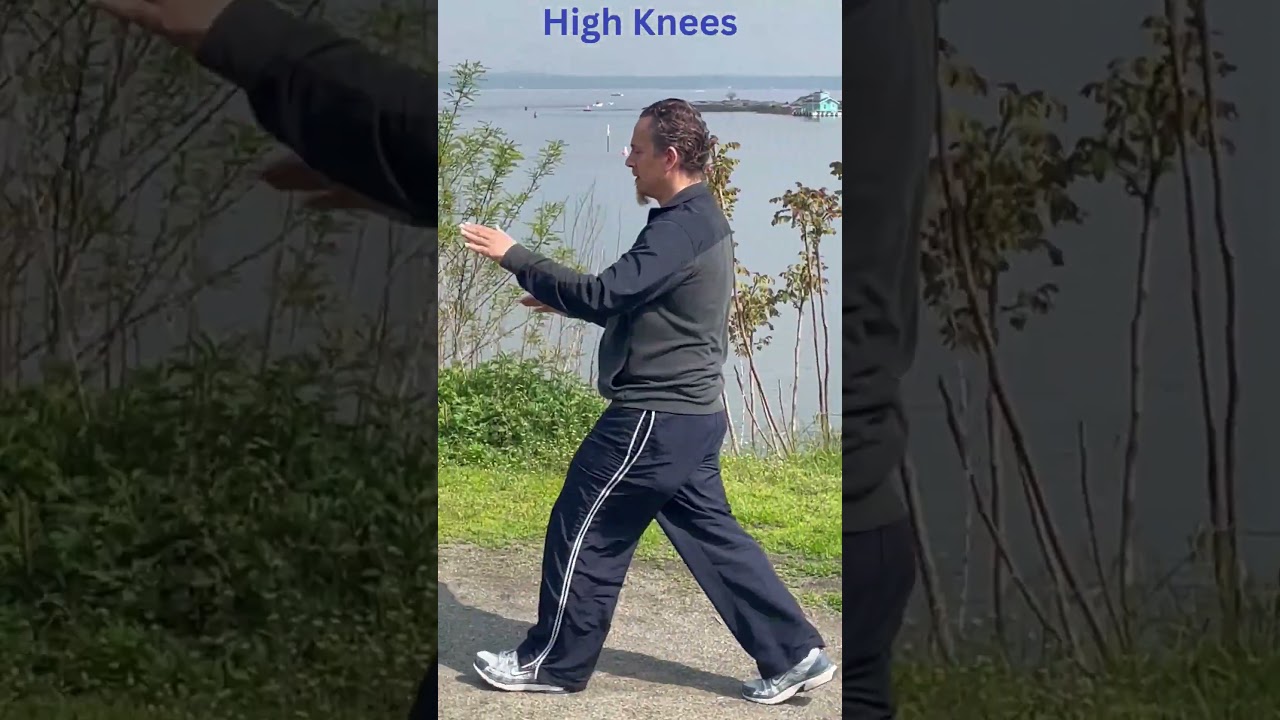
Sets: 3 Reps: 5 each side Rest: 30sec
How to do it:
- Stand upright with your feet hip-width apart.
- Take a step on the spot, raising one knee as high as possible, then placing your foot back where it started.
- Do the same on the other side.
- You can also do this exercise while in motion (as in the video) by taking exaggerated steps, as though stepping over an obstacle.
- Alternate sides until your set is complete.
You can hold your hand out to gauge how high you are lifting your knee and challenge yourself to get your thigh high enough that it hits your palm.
Peter Conroy is the founder and CEO of The Difference, a weight-management technology designed to be predictive, intuitive, and affordable.
He holds a certificate in personal training from the National Academy of Sports Medicine and has over a decade of experience in health advocacy and awareness.
