





This is one of the most important exercises you can do before you hit 60, according to a personal trainer who works with seniors
Doing the kneel-to-stand exercise now can mean greater independence as you age


Falls are a pressing concern for my senior personal training clients. According to the CDC, falls are the leading cause of injury for adults 65 and older, but fortunately, falls are also preventable.
Appropriate strength training is one of the best ways to prepare for healthy aging and prevent serious falls. When I work with a client in their 30s, 40s or even 50s, I make sure that the kneel-to-stand exercise is a part of their regular routine.
This movement trains multiple lower body muscle groups like the quads, hamstrings, glutes and core, promoting better coordination and enhancing full-body stability.
“The kneel-to-stand exercise is very functional and something we should all be practicing,” says Dr Theresa Marko, DPT, owner of Marko Physical Therapy and adjunct faculty at Touro University School of Health Sciences. “As someone ages and their balance decreases, there is the chance of falling. When someone falls, they need to be able to get up from the floor back to a standing position. This move is vital to make that happen.”
How to do the kneel-to-stand exercise
Before starting any new exercise or workout, notify your doctor. They may suggest alternatives or caution against certain activities based on your personal health history. “People with issues such as fractures, torn ligaments, or meniscus tears should avoid this maneuver and work with their physical therapist on modifications,” says Marko. A certified personal trainer can provide guidance on how to do the kneel-to-stand exercise correctly. If you’re a beginner, consider working with a trainer to ensure proper form.
You won’t need any equipment for the kneel-to-stand, but you may want to use a yoga mat, a rolled-up towel, a pillow, or an Airex pad to cushion your knees.
Start by doing one set of 5 reps on each side, 1-2 times per week. If you have trouble doing 5 reps with good form, drop to 2-3 reps on each side.
Once 5 reps feels comfortable, gradually increase your reps to 6-8 on each side. You can also add an additional set or two as your strength improves.
Work your way up to doing 2-3 sets of 6-10 reps, 2-3 times per week. This exercise can be done on its own or as a part of your lower body workout regimen. You can also use it as a warm-up for other activities.
How to do it:
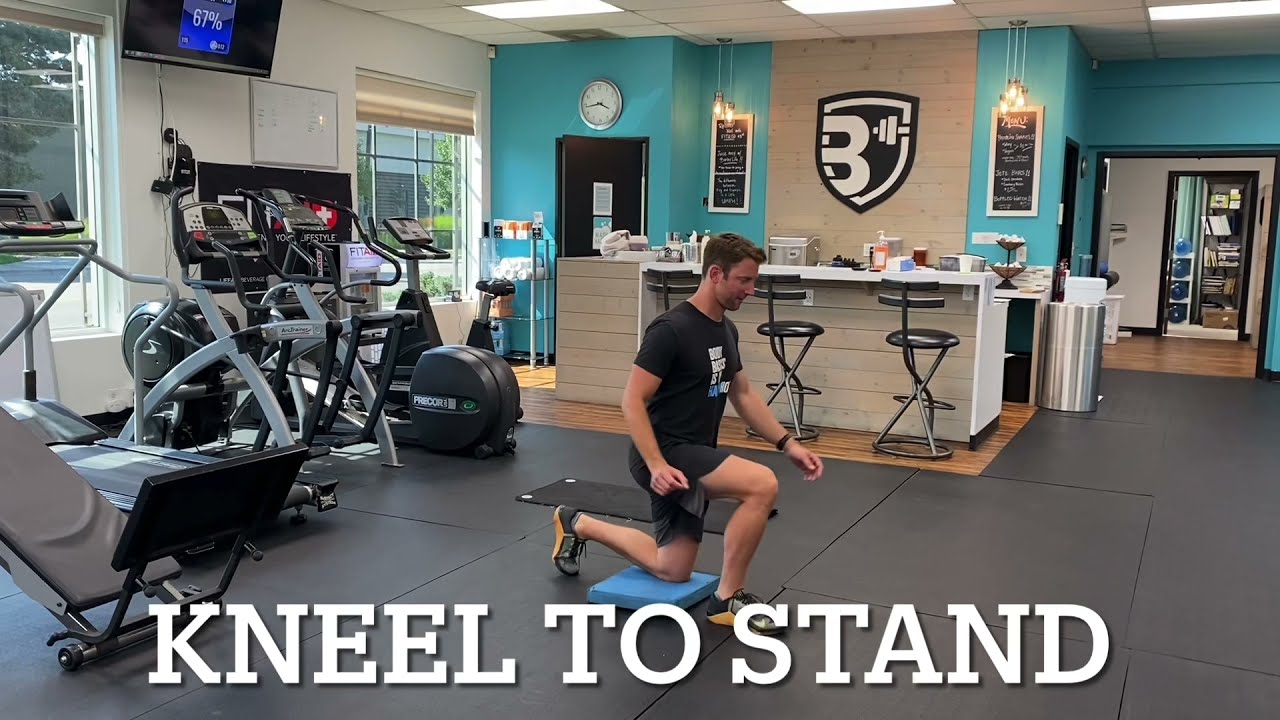
- Stand with your feet hip-width apart.
- Engage your core muscles.
- Step your left foot behind you.
- Bend both knees to lower your left knee onto the floor, directly underneath your hip.
- Bring your right foot behind you and place your right knee onto the floor, underneath your hip.
- Step your left foot in front of you.
- Push through your left foot to stand up, bringing your right foot to the floor in line with your left foot.
- Step your right foot in front of you, bringing you back to the starting position.
Tips: Maintain neutral spinal alignment and avoid any arching or rounding through your back.
“Keeping your hips and knees at about 90° helps people not to feel knee pain as they rise to the standing position,” Marko adds.
How to modify the kneel-to-stand exercise: The kneel-to-stand exercise can be challenging at first. If you’re having trouble maintaining proper form or keeping your balance, you can modify the exercise in a few ways.
First, you can use a wall, chair, or table for assistance. Do the exercise next to a solid structure and hold on for added stability and support. When that starts to feel easy, try doing 1-2 reps without support.
You can also do only the first part of the exercise (called a split squat). This will help build the appropriate strength in the right muscle groups so that you can eventually perform the movement in its entirety. Step one foot behind your, bend both knees to lower the back knee towards the floor, then push through your front foot to stand back up. Use the same solid structure for support if needed.
How to make the kneel-to-stand exercise more challenging: If you can do 6-10 reps of the exercise without much effort, it may be time to increase the difficulty.
The easiest way to up the ante is by adding more reps. Instead of 6-10, try 12-15 on each side.
You can also hold a 5-10lb dumbbell or kettlebell as you perform the movement. Hold one weight at chest level, or hold two weights at by your shoulders. Since this increases the load your muscles will have to work against, drop your reps to 3-5 for the first few attempts. Increase your reps back to 6-10 once you feel comfortable.

Dr Theresa Marko is the founder and owner of Marko Physical Therapy, PLLC, a private practice in New York City, specializing in orthopedics and adolescents. She is also an adjunct faculty member at Touro University School of Health Sciences Doctor of Physical Therapy program and Tufts University Seattle hybrid program. She is passionate about making a change in health care and has made advocacy a cornerstone of her practice.
