




Over-50s who pass this 10-second balance test have better predicted longevity—here’s how to improve your balance at any age
Maintain the ability to move confidently, react quickly and stay independent as you age, says Jacque Crockford


Can you stand steady on one leg for 10 seconds?
That was the test put to 1,702 individuals in one longitudinal study on over-50-year-olds, with findings showing that those who can have a lower risk of all-cause mortality.
In the study published in the British Journal of Sports Medicine in 2022, participants across an 11-year period were assessed on their ability to stand on one leg for 10 seconds without losing balance.
This data was then cross-referenced against anthropometric measurements, including waist circumference and body mass index (commonly known as BMI), to interpret the role of these variables on survival rates and risk of mortality.
“That research has shown balance can actually be a meaningful marker of overall health and longevity,” says Jacque Crockford of the American Council on Exercise (ACE).
“Balance and core strength are foundational components of healthy movement and long-term independence,” she tells Fit&Well. “For older adults in particular, balance training is one of the most effective strategies for preserving independence and reducing fall risk.”
How to perform the 10-second one-legged stance test
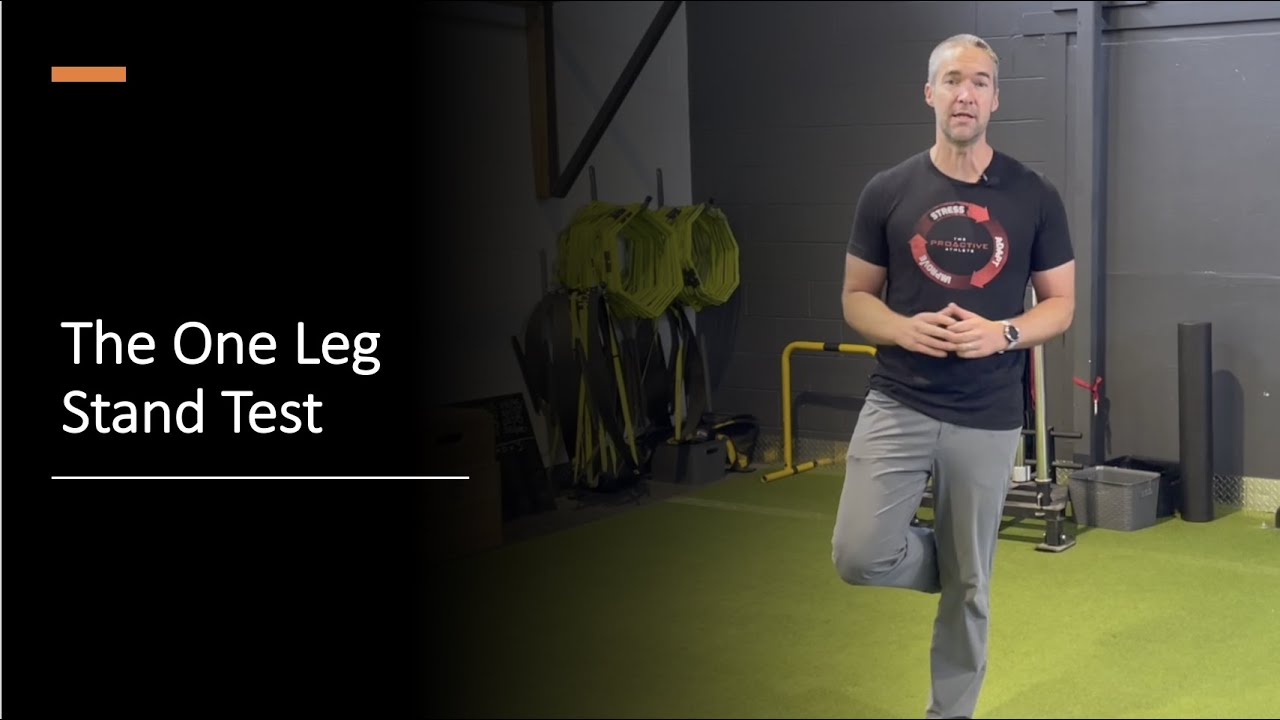
In the study, the balance test was performed barefoot, with arms relaxed by their sides and eyes open.
They were asked to lift one foot off the floor and rest it against the back of the opposite lower leg, rather than holding it raised in free space.
Both left and right legs were tested and timing only started once in position with one foot resting on the other leg.
A pass was determined if the participant could hold this one-legged stance unbroken for a full 10 seconds.
What did the results show?
Of the 1,702 individuals assessed in the prospective cohort study, 20.4% failed the balance test, with pass rates declining with age.
For example, 4.5% of participants aged between 51-55 failed the test, compared with 53.6% for those aged 71-75.
Age Groups (Years) |
Single-Leg Stance Test Fail Results (%) |
51-55 |
4.7 |
56-60 |
8.1 |
61-65 |
17.8 |
66-70 |
36.8 |
71-75 |
53.6 |
How to interpret your score
While Crockford acknowledges that tests like this can provide useful information in structured assessment settings, they’re really “just snapshots” in time.
“[The 2022 study] doesn’t mean standing on one leg causes longevity,” she says.
“But it does suggest balance reflects multiple systems working well together, including muscular strength, neurological function and mobility.”
Most people, she adds, don’t necessarily need a formal balance assessment to know whether balance and core stability are areas they should work on.
“The real question is: how confidently and comfortably can you move through daily life?”
How to improve balance at any age
For most people, Crockford says you should focus less on passing a test, and more on “maintaining the ability to move confidently, react quickly and stay independent as you age”.
For example, can you walk up stairs without grabbing the railing? Can you step over a curb smoothly? Can you get up off the floor easily? Or stand on one leg while putting on a shoe?
“Those are all real-world expressions of balance, stability and core control,” she says.
So, while there is value in practicing the single-leg stance test to improve your score, a better use of your time would be to include real-world activities that challenge your balance in a safe setting.
“Strategies include simple things like single-leg exercises, walking on uneven surfaces, strength training, yoga, tai chi and even standing on one foot while brushing your teeth,” says Crockford.
“These can all help improve balance and stability over time.”

Jacque Crockford, DHSc, is the director of product development at the American Council on Exercise (ACE), where she leads the production of innovative, science-backed education for health and fitness professionals. She is also an ACE-certified health coach and personal trainer with more than 20 years of experience as a trainer, educator and coach, dedicated to making movement safe, effective and accessible.
“Successful 10-second one-legged stance performance predicts survival in middle-aged and older individuals” in British Journal of Sports Medicine
