I tried doing banded pull-aparts every day to improve my posture—here are my results
My upper-body strength and mobility definitely improved


I’ve worked as a personal trainer for 15 years, but I still struggle with poor posture. Spending a lot of time in front of a computer has weakened my upper back and shoulders, and tightened my chest muscles considerably.
After catching a glimpse of my rounded shoulders in the mirror one day, I decided it was time to get serious about improving my posture. To get the ball rolling, I added banded pull-aparts to my daily workout every day for two weeks, as this exercise targets muscle groups in the shoulder that can become weakened after long periods of sitting.
After my experiment was over, I noticed a big difference not only in my posture but also in my overall upper-body strength.
How to do the banded pull-apart
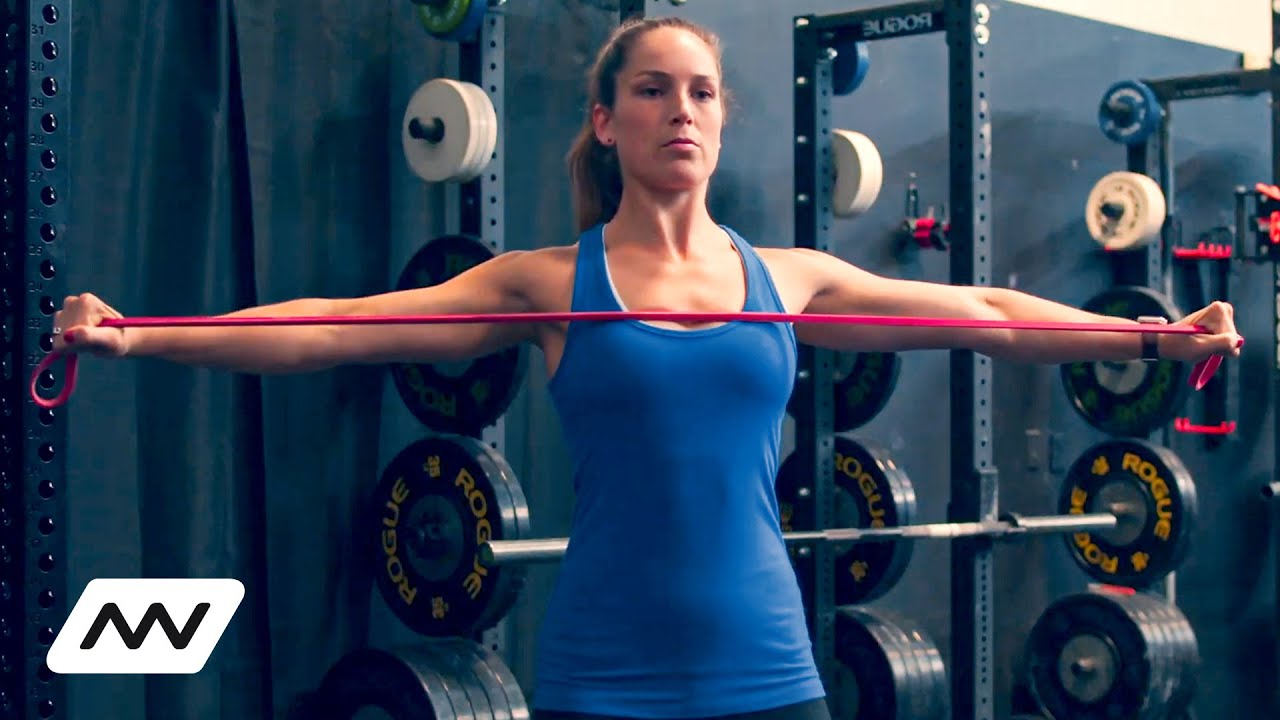
You’ll just need a light long resistance band for this exercise, like this one.
- Stand with your feet hip-width apart.
- Hold the resistance band with your hands shoulder-width apart, and light tension in the band.
- Engage your core muscles.
- Lift the band to shoulder height, with your arms extended.
- Keeping your arms extended, move your hands out to the sides, stretching the band as it moves closer to your chest.
- Slowly return to the starting position with control.
- Continue for the desired number of reps.
I wanted to be sure that doing banded pull-aparts every day would be safe, so I asked Dr Michael Steimling, PT, DPT, assistant professor in the Doctor of Physical Therapy program at Moravian University, for his advice.
“A banded pull-apart exercise would train the deltoid muscle, portions of the rotator cuff and the scapular stabilizers, including the middle trapezius and rhomboid muscles,” he said. “Training these muscles should be part of any regular fitness routine, and if resistance is light (enough to easily complete more than 10-12 reps without a rest), this exercise could be completed every day without serious risk of injury.”
“However, for most forms of resistance exercise, I would not generally recommend that patients complete them every day. A more sustainable prescription might be three or four days a week,” he added.
Keeping Steimling’s guidance in mind, I started my two-week regimen with 1 set of 10 reps. Once I started to build up a bit of strength, I increased to 2 sets of 12 reps each day. Here are my observations.
1. It was hard to keep my upper shoulders relaxed
One of the biggest challenges of this daily exercise was keeping the upper shoulders relaxed as I pulled the band apart. At first, I had to lessen the resistance by starting with less tension in the band. Eventually, I was able to activate the appropriate muscle groups.
I got stronger with each passing day, and by the end of the first week I was able to use my rear deltoids, middle traps, and rhomboids to perform each rep. Facing this form challenge gave me insight on how better to cue my clients when I ask them to do this move.
2. My shoulder range of motion improved
Sitting at a computer can negatively affect shoulder mobility, and that, combined with lots of overhead pressing, has wreaked havoc on my shoulders.
After a few days of banded pull-aparts, I could tell that my chest was opening up. When the two weeks were over, I noticed that I had far less restriction in the joint, and the usual pain I got when pressing was diminished.
Even if this exercise hadn’t improved my posture (more on that below), these positives would be enough to call my experiment a success.
3. I sat taller at my desk
My goal was to improve my posture, and I could definitely see some improvements after two weeks’ time. I wasn’t slouching forward at my computer anymore (raising my keyboard also helped), and I wasn’t ending the day with a neckache.
While I may not continue doing banded pull-aparts daily, I will definitely keep doing them a few times a week.
Shop resistance bands
Dr Michael Steimling is an assistant professor in the Doctor of Physical Therapy program and is the primary academic faculty for the musculoskeletal series at Moravian University.
He has been an ABPTS board-certified clinical specialist in orthopaedics since 2015 and a Fellow of the American Academy of Orthopaedic Manual Physical Therapists since completing the Fellowship in Orthopaedic Manual Therapy from Regis University in 2018.
He has published his research in peer-reviewed journals, presented at local, state, and national conferences, and received funding from the Pennsylvania Chapter of the American Physical Therapy Association.
