I swapped dumbbell chest presses for resistance band chest presses for two weeks and my shoulder pain instantly improved
They’re now a permanent part of my workout program


Returning to exercise after childbirth has been a challenge.
I knew that improving my endurance would be tough, but I thought I might keep my strength levels up by continuing to train throughout pregnancy. Unfortunately, that wasn’t the case.
A weaker upper body, plus some nagging shoulder pain, means my usual supine dumbbell chest presses have felt particularly hard.
I decided to try using a resistance band to perform a standing press instead. It’s a method that I’ve previously had success with, swapping dumbbell rows for resistance band rows.
Here’s what happened when I made the same switch with my chest presses for two weeks.
How to do a resistance band chest press
Sets: 1-3 Reps: 15
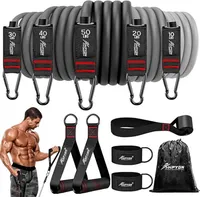
You’ll need: a moderately-heavy resistance band and a secure anchor point, like a stair railing, or a door if your resistance band comes with a door anchor attachment.
How to do it:
- Loop the band around the anchor point.
- Face away from the anchor point and take the ends of the band in each hand.
- Step forward until the band is taut.
- Stand with your feet hip-width apart, or in a split stance with one foot in front of the other to help with stability.
- Bring your hands to chest level with your elbows bent, positioned behind your torso.
- Engage your core muscles.
- Extend your arms forward, pushing the ends of the band away from you until your hands meet in front of you.
- Pause briefly, then slowly bring your hands back to your chest.
My experience
I started off my experiment by doing one set of 15 reps using a 40lb band. I’d been using two 20lb dumbbells for my chest presses, so this was about the same resistance level. I would advise beginners to start with a much lighter band.
After seven days, I added an additional set of 15 reps and switched to a 50lb band.
On day 10, I was able to complete three sets of 15 reps, which I continued to do until the end of the two-week period.
Here are my results.
My shoulder pain improved
I’ve been dealing with pain in my right shoulder for years, and carrying a baby for most of the day certainly hasn’t helped. My initial motivation for trying resistance band chest presses was to relieve some of that pain, and fortunately, I noticed improvements within the first few days.
I asked Dr Sean Cronin, a physical therapist and certified orthopedic specialist working with Hartford Healthcare Rehabilitation Network, for his thoughts on why the swap was beneficial.
“When working with dumbbells, the stress on the muscles and shoulders is the highest at the bottom of the eccentric phase, or when your hands are closest to your chest,” he explains.
“This is also the most common phase where people experience shoulder pain due to weakness and instability.
“Resistance bands adapt to length, meaning that they provide the least resistance at the bottom phase where you may be unstable, and most resistance at the middle and top range. This property allows you to strengthen your muscles in areas where dumbbells cannot.”
Transferring more of the resistance to the middle and end range of my chest presses allowed me to build more power in that portion of the movement.
When I returned to dumbbell chest presses, I relied less on any momentum from the bottom of my range, and could perform each rep slower and with a lot more control. I still had some shoulder pain, but it had decreased significantly.
My overhead presses felt better
The shoulder is involved with most upper-body movements, so it didn’t surprise me when other exercises, like dumbbell overhead presses, started to feel more stable too.
Cronin explained that chest presses are great for building shoulder stability, but your equipment can make a difference.
“Many people are familiar with utilizing the barbell and dumbbells for this motion, however neglect the use of resistance bands, which means they are missing out on training at least half of the range of motion.”
Similar to my chest presses, my overhead presses felt like they had more power towards the middle and the end of each rep. I may end up making the same swap with my overhead presses in the future, to further improve my form.
I kept doing them after the two weeks was over
Cronin emphasized the importance of using multiple training modalities to achieve optimal strength levels.
“I would be remiss if I didn’t acknowledge the benefits of utilizing both dumbbells and resistance bands within your routine, even if you are pain-free and have a stable shoulder,” he says.
“They each target a different portion of the movement, allowing us to strengthen our chest and shoulders throughout the entirety of the motion.”
At first, I planned to ditch the resistance band chest presses once the two weeks were over. Now, I understand their importance and place in a comprehensive upper-body program, so like my resistance band rows, they’ll have a permanent place in my warm-up.
Dr Sean Cronin is a proud graduate of Sacred Heart University's DPT (Doctor of Physical Therapy) program. He serves on the Sports Medicine SIG Council at Hartford Healthcare (HHC), where he leads the development of the Diagnostic Ultrasound program and assists in developing sports rehabilitation education for DPTs. He provides care at HHC’s West Haven clinic as well as providing sideline medical management and leading sporting events throughout Connecticut.
