Is one arm stronger than the other? Here’s a simple way to find out and what to do about it
Use this dumbbell workout from Arnold Schwarzenegger’s Pump Club newsletter to “find your weakness,” then follow our beginner tips to turn it into a strength


Personal trainers often talk about correcting imbalances, because identifying a weakness on one side of your body when performing an exercise, then correcting it, can reduce the risk of injury. But what does that actually look like in practice?
That’s exactly the topic addressed in the Arnold’s Pump Club newsletter with a unilateral dumbbell workout.
Designed to “find your weakness”, the five-move workout alternates between a one-sided lower- and upper-body lift, then another one-sided move for the core.
Working one side of your body at a time, the editors of Pump Cub write, “will make it harder to avoid your strength imbalances, meaning you’ll know what you need to work on if you want to become stronger and more durable.”
I think it’s a fantastic workout for everyone to try, but it requires two sets of dumbbells, which many people don’t have, so I’ve offered an alternative approach for people who only have a pair of medium dumbbells to hand.
Once you’ve used the workout to identify any imbalances, I also have a suggestion for how to use the same workout to fix those imbalances over time.
How to do the workout
In the original workout (scroll to the bottom of this Pump Club newsletter to read it) the first of two circuits is performed doing 10 reps with the lighter dumbbells, while the second circuit is performed doing 5 reps with heavier dumbbells.
Going lighter, then heavier will help you “better understand whether the imbalance applies to muscular endurance, strength or both,” the editors write.
If you only have one set of medium-heavy dumbbells, as I do, aim for 12-15 reps for the lower-body lifts and 8-10 reps for the upper-body moves in the first round.
On the second round, do 5 reps, then finish with an isometric hold—pausing for five seconds halfway through the rep—to test your joint stability and control.
Here’s how to do my revised version, followed by form guides.
Circuit 1
Do two rounds of the following.
- Single-leg Romanian deadlift (left side)
- Single-arm overhead press (right side)
- Single-leg Romanian deadlift (right side)
- Single-arm overhead press (left side)
Single-leg Romanian deadlift
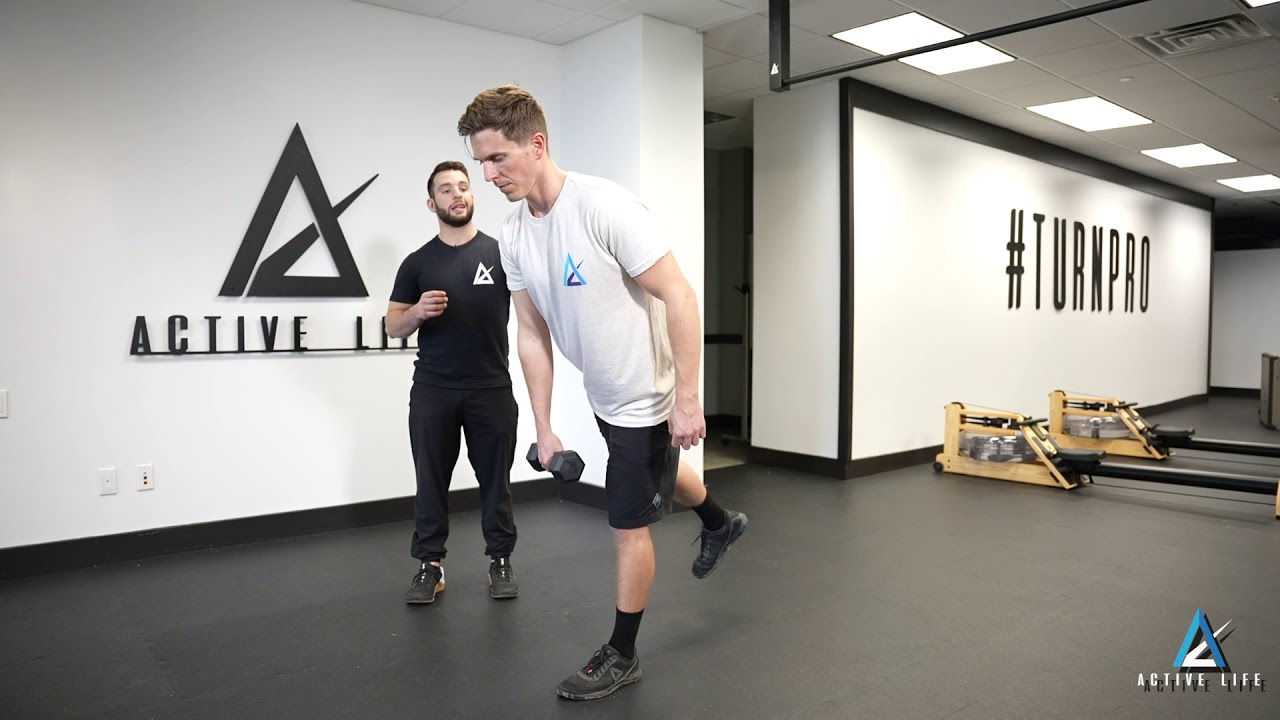
Reps: 12-15; 5, plus 5-10sec hold
How to do it:
- Hold the dumbbell in your right hand and keep your left foot planted.
- Hinge forward at the hips to lower your torso and the dumbbell and lift your right leg behind you.
- On the second round, pause at this lowest point with the greatest tension in the hamstrings of your standing leg.
- After five to 10 seconds, drive your hips forward to return to the start.
Single-arm overhead press
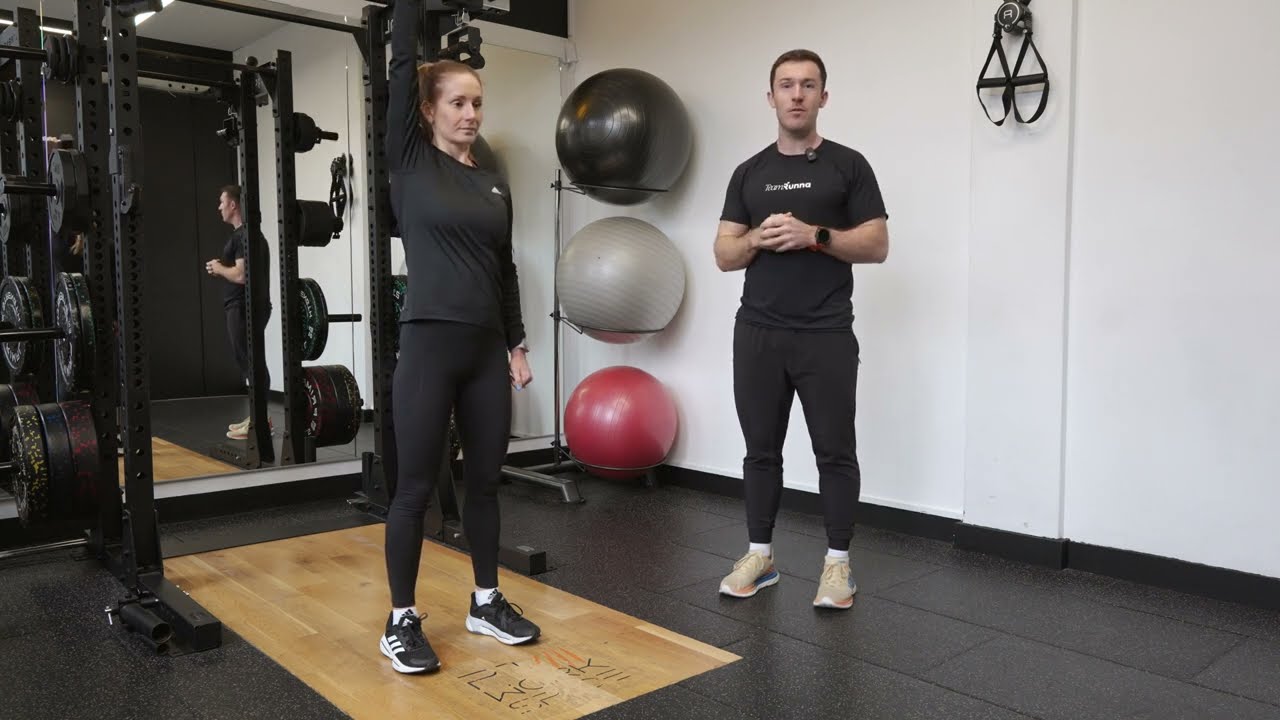
Reps: 12-15; 5, plus 5-10sec hold
How to do it:
- Stand holding a dumbbell in your right hand by your right shoulder.
- Extend your arm to press the dumbbell straight up.
- On the second round, pause with the weight at its highest point, keeping your ribs down, your biceps close to your ear and core engaged.
- After five to 10 seconds, lower the weight under control to complete the rep.
Block 2
Do two rounds of the following.
- Bulgarian split squat (left side)
- Single-arm row (right side)
- Bulgarian split squat (right side)
- Single-arm row (left side)
Bulgarian split squat
Reps: 12-15; 5, plus 5-10sec hold
How to do it:
- Holding a dumbbell or dumbbells, place the top of your right foot on a bench behind you.
- Bend your left knee to lower.
- On the second round, pause at this lowest point with the greatest tension in the quadriceps of your standing leg.
- After five to 10 seconds, push through your left foot to return to the starting position.
Single-arm row
Reps: 12-15; 5, plus 5-10sec hold
How to do it:
- Support your weight with your left hand on a bench and hold a dumbbell in your right hand.
- Create a stable base between your supported hand and feet.
- Lift the dumbbell to your right hip.
- On the second round, pause with the weight at its highest point, focusing on keeping the dumbbell tucked close to your hip and back muscles retracted and engaged.
- After five to 10 seconds, lower the weight under control to complete the rep.
Block 3
Do two rounds of the following.
- Suitcase carry (left side)
- Suitcase carry (right side)
Suitcase carry
Time: 40sec each side
- Stand holding a dumbbell in your left hand by your left side, with your back flat and chest facing forward.
- Walk forward, or in a figure of eight if space is limited, for 40 seconds.
- Concentrate on keeping your body upright and not allowing the weight to pull you over to one side.
What to do if you identify an imbalance
If you do identify an imbalance with an exercise, the best course of action is to work on rebuilding your strength with your weaker side as the baseline.
That will mean doing fewer reps than you can manage on your stronger side while the weaker side catches up, but that will eventually allow you to progress your strength on both sides evenly.
For example, if you can manage 10 overhead press reps on your right arm but only eight on your left, next time you perform the workout aim for eight reps on both sides.
Stick with that for a week, repeating the workout once or twice, then next week aim for nine reps each side. The following week, go for 10, or increase the weight fractionally.
That gradual progression will help rebuild your strength evenly, ensuring one side of your body isn’t compensating for the other, thereby lowering the risk of injury over time.
