How to injury-proof your body after 40—five expert-backed habits that keep you active for life
Build resilience and strength safely with these expert tips


If you are 40 or over and find yourself feeling achy more often, you’re probably not imagining it.
In midlife, your muscles, bones and tendons naturally start to change, explains Jill Jones, an ISSA-certified personal trainer, owner of Newark’s Colosseum Gym and co-founder of FitQuo.
This can make us more vulnerable to injuries and strains.
“Here's the thing nobody tells you about turning 40—your body doesn't betray you overnight. It's not one bad step off a curb that does you in. It's years of skipped warm-ups, ignored stiffness and treating your body like it's still 25,” says Jones.
Most people can get rid of their aches and pains with the right approach.
“It's just a different job now and once you know the job, you can absolutely stay strong, active, and injury-free for the long haul.”
Along with Jones, I spoke to Andrew Gorecki, doctor of physical therapy and author, about the best habits to adopt in your 40s and how they improve your longevity.
1. Wake up your tendons
Tendons naturally become less elastic with age, and take longer to adapt to exercise, increasing the risk of stiffness and injury.
But using isometric exercises—where you hold a position under load without moving—can act as a gentle wake-up call for aging tendons, says Gorecki.
“Holding a position—such as a wall sit, calf raise or split squat—under tension helps gently activate the muscles while gradually loading the tendon without the higher impact of dynamic movements,” he says.
“This not only encourages tendons to stay strong by stimulating collagen production and remodelling, but can also temporarily reduce tendon pain, making them an excellent way to prepare your body before strength training or more demanding exercise.
“That's why isometric exercises have become a common first-line intervention for painful tendons.”
Gorecki recommends doing this isometric exercise below.
Calf raise
Sets: 4-5 Hold: 30-45sec Rest: 1min

- Stand on the balls of your feet on a step, heels hanging off the edge.
- Hold something sturdy for balance if needed.
- Raise your heels as high as you can, balancing on the balls of your feet.
- Hold for 30-45 seconds, squeezing your calves.
- Slowly lower. Avoid going too low if your Achilles is sensitive.
Make it harder: Progress to single-leg holds once this feels easy.
2. Build your balance before you need it
Balance training is overlooked as an injury prevention tool, says Gorecki.
“Most people think of balance as fall prevention, which it is, but there's a bigger picture. Every step you take, every reach, every catch, is a small balance challenge.
“When the balance system weakens, the body compensates by moving more cautiously and loading joints unevenly, which creates the small overuse patterns that become injuries for an older population.”
Gorecki adds: “Balance is also a neurological skill more than a muscular one. The nervous system needs practice sending small corrections to small muscles. When you stop practicing, you lose the skill fast.”
He recommends doing this simple balance exercise daily, which also trains your foot to move in different planes of motion.
Three-way single-leg reach
Reps: 5 each direction
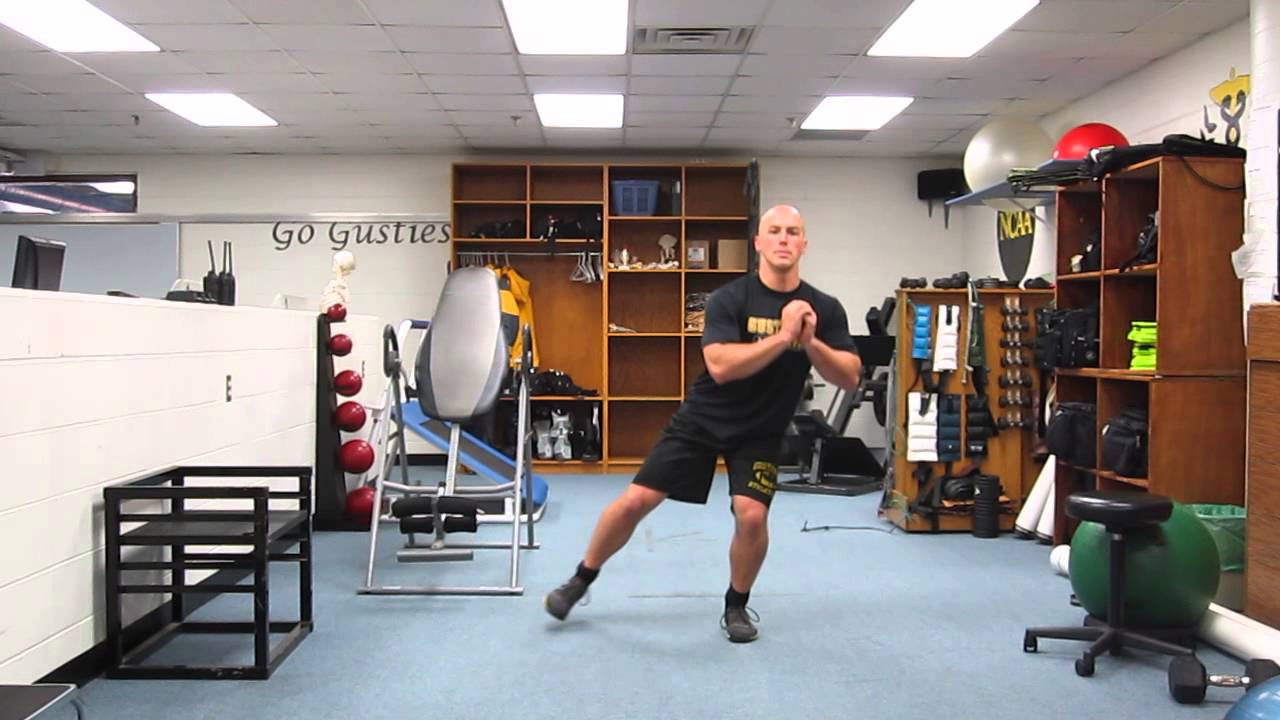
- Stand on one leg. You can place your fingers on a sturdy surface for support if needed.
- Extend your raised foot to touch your toes on the floor in front, then return to center.
- Repeat to the side, then behind you.
- Do five reaches in each direction, then switch legs.
Gorecki says this exercise “builds real-world balance. Training the body to control single-leg balance while the other leg moves in multiple directions mimics real life”.
3. Use movement snacks to combat stiffness
Gorecki says the body adapts to what you do the most, so if you spend eight hours a day sitting that’s what it will get used to.
Breaking up sitting with bite-sized moments of movement—what he calls movement snacks—helps to change that.
“Just two to five minutes of intentional movement, done three to eight times a day, can help keep your joints lubricated and your connective tissues elastic.”
“This is one of the highest leverage interventions for people over 40 because it addresses the accumulated stiffness that makes injuries more likely,” he says.
He recommends weaving this movement snack into your day:
Standing thoracic rotation
Reps: 10 each side
- Stand with your feet shoulder-width apart, arms crossed over your chest and your hands on opposite shoulders.
- Slowly rotate your upper body to the right as far as comfortable.
- Hold for a few seconds, return to center then rotate to your left.
Try doing this every 45-60 minutes of sitting, he says.
“The mid-back stiffens with sitting more than almost any other region of the body. This snack keeps it mobile enough that the low back and neck don't have to compensate.”
4. Take a recovery walk
Everyone should have rest days, but they become even more important as you get older.
“At 40 and beyond, recovery just takes longer than it used to. That's biology—we can't argue with it. But we can take proactive steps to getting our bodies closer to their optimal state,” says Jones.
She recommends taking recovery walks on rest days.
“A slow, easy walk the day after a hard workout isn’t wasting a day”, says Jones.
“It’s helping promote recovery by increasing blood flow and reducing stiffness without adding more stress. I build these into every client’s week, no exceptions.”
5. Progress gradually—even if you’re already fit
Once you hit 40 and over, strength training should be a non-negotiable.
It helps preserve and maintain muscle mass and bone density, supports healthy joints and metabolism and builds the strength and stability needed to stay active and reduce injury risk.
But before you increase the weight, add more reps or make exercises more challenging, it’s important to know if your body is ready.
Gorecki recommends using four simple checkpoints before progressing your workouts.
“The first signal I look for is whether the current load feels controlled through the whole range of motion,” he says.
“For example, if you're squatting, you should feel stable whether you're lowering [the weight] a few inches or performing a full squat.”
The second signal that you're ready to move up a weight, according to Gorecki, is if you can perform an exercise both slowly and quickly without losing form.
The third checkpoint is how sore you are after upping the load.
“Some muscle soreness for 24 to 48 hours is normal, but if it lasts longer, it may be a sign you've progressed too quickly,” says Gorecki.
Finally, he says if you’ve been at your current level for at least two to three weeks, it might be time to change things up.
“Consistency at any level is what actually builds tissue capacity. Rushing progression is one of the leading causes of overuse injuries in this population,” he says.
Gorecki adds: “None of these tips require expensive equipment or long workouts. They require paying attention to the small habits every day.
“The people who stay active into their 70s and 80s aren't the ones who trained hardest at 40. They're the ones who built the daily practice.”
