




I tried doing this one stretch every day for two weeks and it helped me run pain-free
The standing IT band stretch helped me to regain my mileage after a long break from running


I love running, so having to take an extended break during pregnancy and postpartum recovery was tough.
I couldn’t wait to lace up my sneakers once I got the go-ahead from my doctor.
Unfortunately, my return to running hasn’t been as smooth as I’d hoped.
I figured that I’d need to start slow and with short distances, but when an old running nemesis—IT band syndrome—reared its ugly head, it almost stopped me before I made any progress.
“IT band syndrome is basically lateral knee pain that's actually deriving from the hip and the lateral hip muscles,” says Dr Zaki Afzal, owner and founder of Optimize Physical Therapy and Performance.
“The IT band is a dense collagen tissue that attaches to the TFL muscle up at the hip, and runs all the way down to the outside of the knee,” explains the physical therapist.
“What causes the syndrome is irritation of that tissue at the outside of the knee, where it gets a little compression.”
Not wanting to give up my runs, I decided to focus on alleviating the pain and fixing my IT band syndrome once and for all.
Part of my strategy was to do this standing IT band stretch every day for two weeks.
Azfal confirmed that the stretch was safe to do daily, so I set out on my two-week experiment.
Before getting started
The standing IT band stretch is appropriate for all fitness levels, but you should consult with your doctor before trying it yourself, incase your knee pain is actually something else.
It’s also important to note that calling this move (demonstrated below) an IT band stretch isn’t entirely accurate.
“The IT band is not built to be stretched,” explains Azfal.
“The forces needed to deform tissue like this are way beyond anything you can apply with your hands or a stretch, and the IT band is firmly anchored to the thigh bone along its whole length, so it's not some loose strap you can lengthen.
“Where you actually get an effect is in the muscle it attaches to, the TFL, and the rest of the lateral hip musculature,” he continues.
“Those [muscles] you can influence, and that's what shows up downstream as feeling looser [in the knee].”
If you’re a beginner, consider meeting with a certified personal trainer or physical therapist to ensure that you’re doing the stretch correctly. A trainer or therapist can also provide modifications or alternatives if you can’t do the standard version of the stretch.
How to do the standing IT band stretch
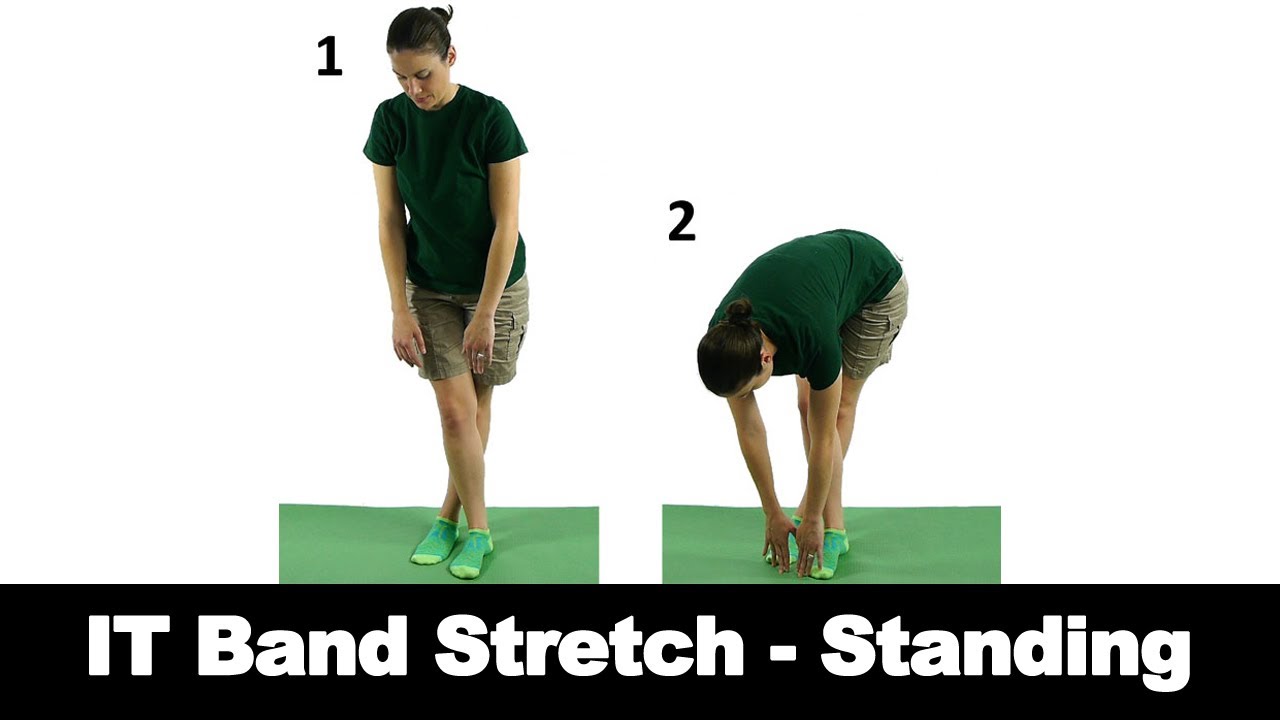
Hold: 15-45sec
- Stand with your feet hip width apart.
- Cross your left leg behind your right leg, placing your feet next to each other (or as close together as possible).
- Bend forward and reach towards your toes. You should feel the stretch in your left leg.
- Hold for 1530 seconds (you can build up to 45 seconds for week two).
- Stand up slowly.
- Repeat on the other side.
How I did the standing IT band stretch
While I don’t run every day, I decided to do the standing IT band stretch daily to ensure I wasn’t losing any progress between runs.
I held the stretch on each side for 30 seconds for the first seven days, and then increased my stretch time to 45 seconds for the second week.
I also decided to lean into the hip of the stretched leg during week two. So if my left leg was behind me, I’d lean to the left to deepen the stretch a bit more.
On run days, I’d actually do the standing IT band stretch twice: once before my run, and once after.
I run twice a week, so there were four days in the two-week experiment that I was doubling my stretching time.
Here’s what I learned after two weeks of doing the stretch.
1. I could run further
During the first few months of my postpartum runs, I could only get to about three miles before my knee pain started kicking in, even with proper rest and recovery.
The initial runs during my experiment weren't much longer, but the results were promising. The first run yielded three-and-a-quarter miles before any pain started, and on the second run, I got three-and-a-half pain-free miles.
By week two I hit four miles and was feeling pretty confident. I’d gotten a mile further than I had in a long time without any IT band syndrome-related pain getting in the way.
Unfortunately, I got a little too confident.
2. I had to stop before I hit my five-mile goal
I decided that on the last run of my experiment, I would try to hit five miles.
That’s the distance I’d go regularly before pregnancy, and since I wasn’t feeling any pain with my current mileage, I thought I’d be able to make it to five.
I was wrong. One of the biggest risk factors for IT band syndrome is increasing your distance too quickly, which is how I developed the condition in the first place many years ago.
I made it to four-and-a-half miles before the pain started—and I had to stop.
While I didn’t hit my goal, I was happy to get further than I had in a really long time.
3. I need to fine tune my workouts to rid myself of the pain
Doing this experiment has given me hope that I will get back to my old distances, but as Azfal pointed out, the standing IT band stretch is only a small part of a full solution.
“Hip strength and hip reactive strength matter because your body has to absorb force when you run, and it will either do that with muscle or it will lean on structures like the IT band,” he says.
“Which strategy your body uses depends on the demands you put on it, your training history, and what resources it has available.”
It was clear that my running plan was a case of ‘too much and too soon,’ so I’ll be dialing it back a bit, for now.
But the standing IT band stretch, along with some hip strengthening exercises, will all have a permanent place in my routine.
Dr Zaki Afzal, DPT, is the founder of Optimize Physical Therapy and Performance, one of the largest out-of-network physical therapy practices in the country, which he started in 2019 and has grown to multiple locations across several states. He completed an orthopedic residency at the University of Michigan and a manual therapy and sports fellowship at Ohio State, and he travels with NFL athletes during the season while working with everyone from active adults to Olympic- and pro-level athletes.
