




The five best strength exercises to help seniors climb stairs more easily
Strengthen your leg muscles and improve your balance to keep you confident going up and down stairs


Climbing stairs is something many of us do every day, and maintaining the strength to take each step comfortably can help us stay active and independent as we age.
“Going up stairs is basically a single-leg squat, repeated,” says Ales Ulishchenko, a licensed osteopathy practitioner in Dubai and founder of MindBodyFace, who has a background in orthopedic surgery and musculoskeletal rehabilitation.
“You need strong quads and glutes to lift your body, calves to push off, and enough balance to stand on one leg for a moment. Going down is harder for many seniors, because the front of the thigh has to control the descent.”
He’s recommended five exercises to help older adults build strength for the stairs and move with greater confidence.
How to do the exercises
Ulishchenko advises you to do this routine two to three times a week, with a rest day between sessions.
Start with one set of each exercise and gradually build up to three sets as you get stronger. Rest for 60 seconds between sets, or longer if needed. Follow the repetitions listed below; for the single-leg stance, hold for the suggested time on each leg.
Use a sturdy counter or handrail for support during the standing exercises. Choose a low, stable step for step-ups and heel taps, and only move through a range of motion that you can control comfortably.
“Mild muscle effort is fine, but sharp joint pain means stop,” he adds.
“Anyone with a recent joint replacement, dizziness or a fall history should check with their doctor or a physical therapist before starting,” Ulishchenko says.
1. Sit-to-stand
Sets: 1-3 Reps: 8-10 Rest: 60sec
- Sit near the front of the seat of a sturdy chair that won’t move, with your feet flat on the floor and hip-width apart.
- Lean forward from your hips and press through your feet to stand up—use your hands to help you push up from the chair if you need to.
- Bend your hips and knees to lower yourself back onto the chair over about three seconds. Avoid dropping into the seat.
“This builds the quad and glute strength that lifts you onto each step,” Ulishchenko says.
2. Step-up
Sets: 1-3 Reps: 8 each side Rest: 60sec
- Stand facing a low, stable step, around 4-6 inches high, with a handrail or sturdy support within reach.
- Place the whole of your right foot on the step.
- Press through your right foot to extend your right knee, bringing your left foot onto the step.
- Slowly step your left foot back down to the floor, followed by your right.
- Complete all the repetitions leading with your right leg, then repeat on the opposite side.
“This is the stair movement itself, practiced under control,” Ulishchenko says.
3. Heel tap
Sets: 1-3 Reps: 8 each side Rest: 60sec
- Stand on a low, stable step with your toes near the edge, holding a handrail or other sturdy support.
- Shift your weight onto your right leg and move your left foot into the air beyond the front edge of the step—this is your starting position.
- Slowly bend your right knee and hip to lower your left heel—keeping your right knee pointing in the same direction as your toes.
- Lightly tap your left heel on the floor without transferring your weight onto it, then press through your right foot to return to the starting position.
- Complete all the repetitions on one side, then switch legs.
Make it easier: Use a smaller step or only lower your heel as far as you can comfortably control—it doesn’t have to reach the floor.
“This builds the braking strength in the thigh you need for coming down safely, which is where many falls happen,” Ulishchenko says.
4. Heel raise
Sets: 1-3 Reps: 8-10 Rest: 60sec
- Stand with your feet hip-width apart, holding a sturdy counter for support.
- Slowly lift both heels to rise onto the balls of your feet, keeping your weight evenly distributed.
- Pause briefly at the top, then lower your heels to the floor over about three seconds.
- Keep your body upright and avoid rocking forward or using momentum.
“Strong calves give push-off on the way up and ankle control on the way down,” Ulishchenko says.
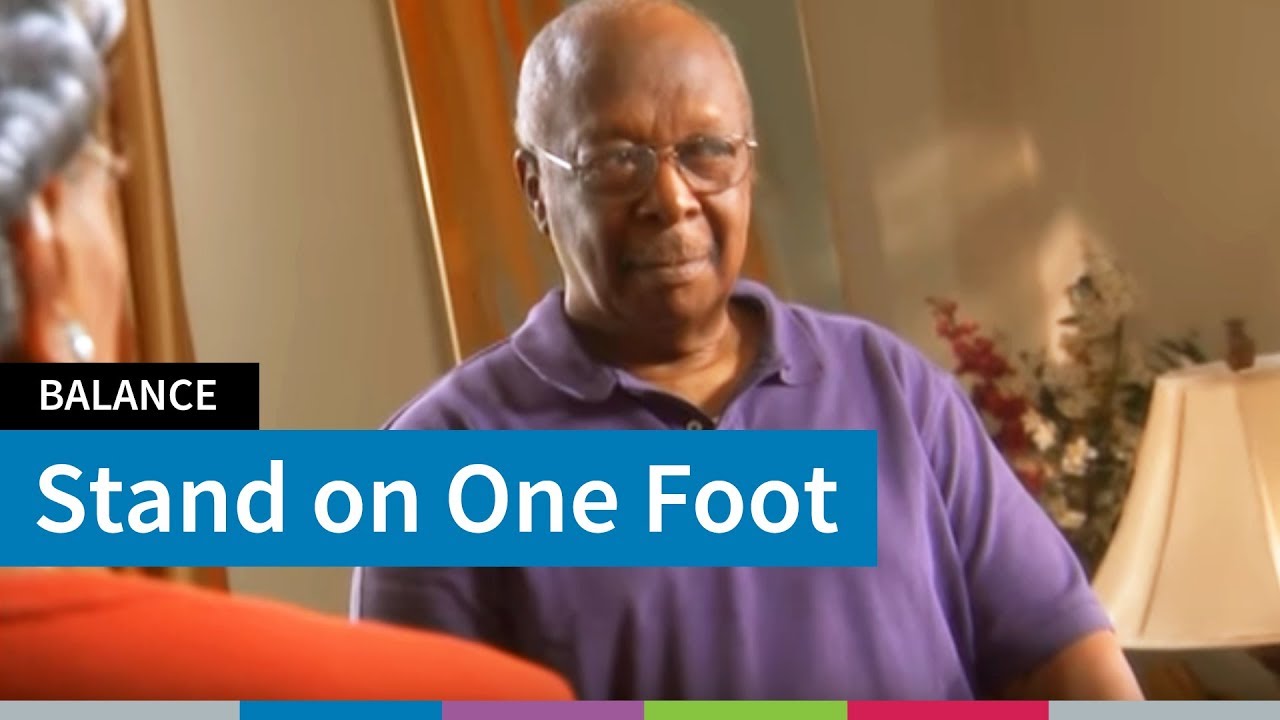
5. Single-leg stance
Sets: 1-3 Time: 5-10sec each side Rest: 60sec
- Stand facing a sturdy counter, holding it for support.
- Shift your weight onto your right foot and lift your left foot a little off the floor. Keep your hips level, look ahead and maintain a slight bend in your standing knee.
- Hold for 5–10 seconds, then lower your foot and switch sides. This completes one set.
- As your balance improves, gradually build up to holding for 30 seconds on each leg. You can also reduce how firmly you hold the counter, keeping it within easy reach.
“Every step means a moment on one leg, and this exercise trains exactly that,” he says.
